
Timeline of the China US Trade Deal: Key Events Explained the China US trade deal timeline is one of the most consequential narratives in modern global economics. This high-stakes saga has shaped financial markets, realigned global supply chains, and influenced political strategies across continents. Understanding the pivotal moments in this evolving relationship offers essential insights into global trade, diplomacy, and economic resilience.
Let’s journey through the major milestones of this complex trade trajectory between the world’s two largest economies.
The Origins of Trade Tensions (Pre-2018)
The economic relationship between the United States and China has always been dynamic—ranging from cooperative to adversarial. Long before the China US trade deal timeline formally took shape, murmurs of dissatisfaction had already begun echoing in Washington.
- Early 2000s: The U.S. began raising concerns over China’s currency manipulation, intellectual property theft, and large trade surpluses.
- 2001: China joined the World Trade Organization (WTO), triggering a seismic shift in global trade dynamics. U.S. imports from China exploded, but so did the trade imbalance.
- 2009–2016: Under the Obama administration, multiple efforts to engage China diplomatically were made, but economic frictions persisted.
Still, these were more like rumblings before the storm.
2018: The Trade War Erupts
In 2018, the trade tensions between China and the U.S. officially escalated into what many dubbed a “trade war.”
March 2018: The Spark Ignites
President Donald Trump announced tariffs on steel and aluminum imports, citing national security concerns. Although aimed at multiple countries, this move directly impacted China, triggering retaliatory thoughts in Beijing.
April–June 2018: Retaliation and Escalation
- April 2018: China imposed retaliatory tariffs on $3 billion worth of U.S. goods including pork, fruits, and nuts.
- June 2018: The U.S. escalated with a 25% tariff on $50 billion of Chinese goods.
- China responded in kind, targeting U.S. soybeans, automobiles, and seafood—a significant blow to American agriculture.
At this stage of the China US trade deal timeline, the tone shifted from diplomatic discord to economic warfare.
2019: A Year of Tit-for-Tat
May 2019: Talks Stall
Negotiations began in early 2019, with both sides expressing a desire to resolve their differences. However, by May, the talks broke down. The U.S. accused China of reneging on key commitments, prompting further tariff hikes.
- The U.S. increased tariffs on $200 billion in Chinese goods from 10% to 25%.
- China hit back with tariffs on $60 billion of American products.
August 2019: Currency Manipulation Claim
The U.S. Treasury labeled China a currency manipulator, exacerbating tensions. Financial markets reacted dramatically, underscoring how deeply this geopolitical chess game had permeated global investor sentiment.
December 2019: Phase One Deal Announced
Finally, after nearly two years of bruising economic blows, a breakthrough was announced. The Phase One trade deal was unveiled in December 2019, laying a provisional foundation for the China US trade deal timeline to enter a new chapter.
January 2020: Phase One Signed
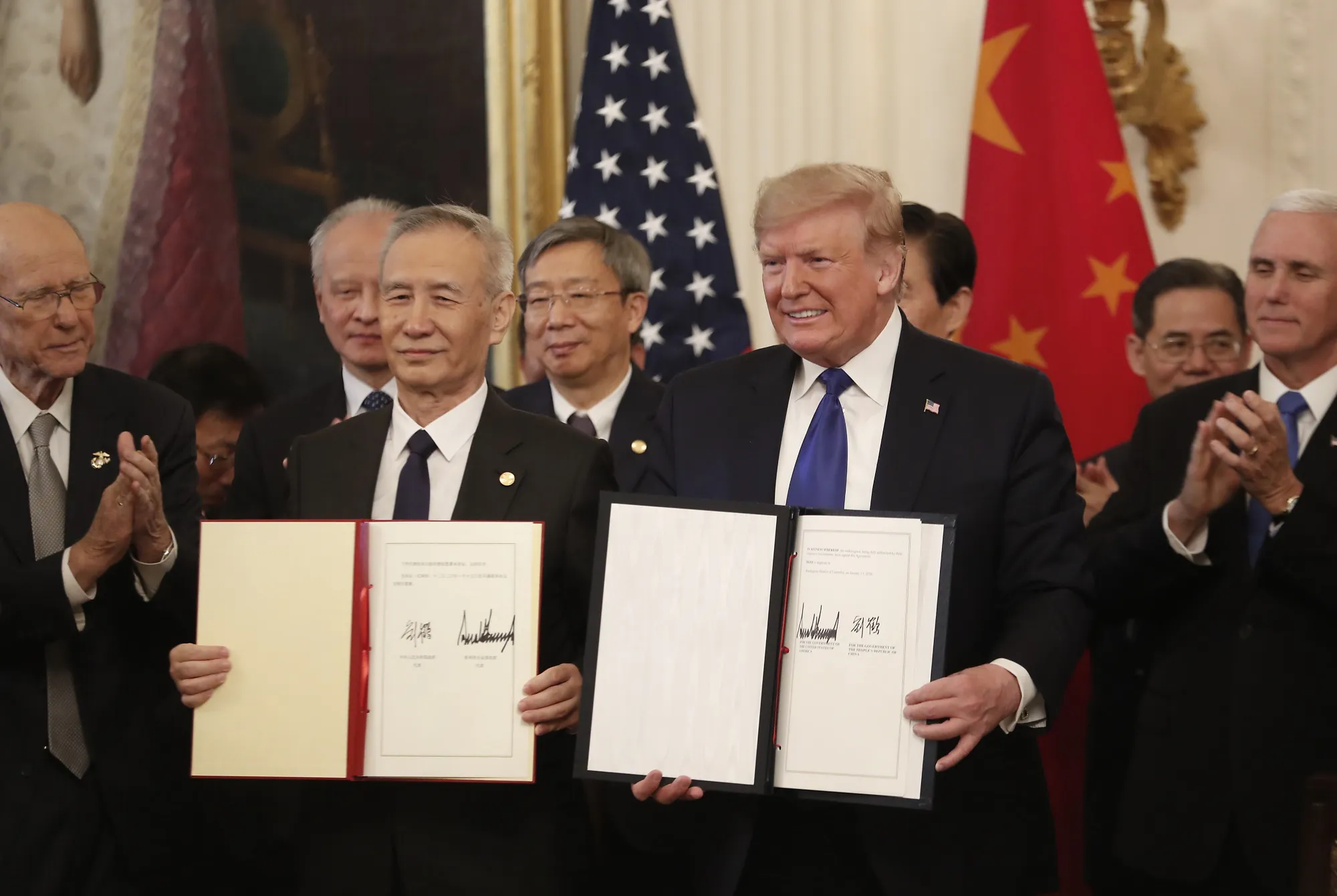
A historic moment arrived on January 15, 2020, when President Trump and Chinese Vice Premier Liu He signed the Phase One trade agreement at the White House.
Key Highlights of the Deal:
- China agreed to purchase an additional $200 billion in U.S. goods over two years.
- Intellectual property protections were strengthened.
- Forced technology transfers would be curtailed.
- Commitments were made to avoid currency manipulation.
- Agricultural purchases, particularly soybeans, were a major focus.
This phase marked a temporary pause in the tariff war. Yet, the deeper issues—like government subsidies and cyber intrusions—remained unresolved.
2020: COVID-19 Disrupts Momentum
Just as the ink dried on the Phase One agreement, the world was hit by the COVID-19 pandemic. The global economy went into a tailspin, disrupting trade flows, manufacturing cycles, and diplomatic momentum.
Mid-2020: Deal in Doubt
- China fell behind in its purchasing commitments due to the pandemic.
- The Trump administration accused Beijing of mishandling the coronavirus outbreak, reigniting tensions.
Nevertheless, both countries maintained that the Phase One agreement remained in force, offering a sliver of stability in a chaotic global landscape.
2021: A Shift in Administration
The U.S. saw a change in leadership with President Joe Biden taking office in January 2021. Many expected a dramatic pivot in trade policy, but the administration opted for continuity rather than overhaul.
Key Developments:
- Tariffs remained largely intact.
- U.S. Trade Representative Katherine Tai emphasized a strategic competition approach.
- The Biden administration initiated a comprehensive review of the China US trade deal timeline and existing tariffs.
Rather than immediate negotiations, the focus shifted to rebuilding alliances and leveraging multilateral pressure on China.
2022: Strategic Realignment
With the world adjusting to post-pandemic realities, both nations adopted a more calibrated tone.
June 2022: Supply Chain Resilience
Washington prioritized strengthening domestic manufacturing, particularly in semiconductors and clean energy. New legislation such as the CHIPS and Science Act indicated a long-term pivot to tech independence rather than short-term tariff fixes.
- Meanwhile, China focused on diversifying trade partners, investing heavily in Africa, the Middle East, and ASEAN nations.
The China US trade deal timeline thus took a more strategic shape, less about tariffs and more about economic positioning.
2023: Attempts to Reengage
By 2023, the diplomatic ice began to thaw slightly.
October 2023: High-Level Dialogues Resume
U.S. Treasury Secretary Janet Yellen and Chinese Vice Premier He Lifeng engaged in extensive trade discussions, signaling a desire to stabilize the rocky relationship.
Focus areas included:
- Tariff rollbacks
- Market access for financial firms
- Enhanced cooperation on climate change
The Biden administration also emphasized de-risking rather than decoupling, acknowledging the reality of interconnected supply chains.
2024: Status Quo or New Foundations?
In the 2024 election year, trade with China remained a hot-button issue. Both major political parties positioned themselves as defenders of American jobs and innovation.
February 2024: Enforcement Talks Intensify
- The U.S. pressed China to meet its Phase One commitments, particularly in agricultural imports and IP enforcement.
- China demanded tariff relief, especially on consumer electronics.
Despite the rhetorical intensity, the China US trade deal timeline didn’t see a major new agreement. Instead, both sides leaned into managed competition, balancing economic rivalry with selective cooperation.
Major Themes and Lessons
Throughout the China US trade deal timeline, several powerful themes have emerged:
1. Tariffs as Tactical Tools
Tariffs became more than economic levers—they were symbols of political will. But their long-term effectiveness remains debated, especially with inflation and consumer costs on the rise.
2. Agriculture as a Battlefield
Soybeans, pork, and corn were front and center in this trade war. U.S. farmers found themselves at the mercy of diplomatic cycles.
3. Technology Supremacy
The real rivalry? It’s in chips, AI, and data sovereignty. As the world digitizes, trade wars are increasingly tech-driven.
4. Global Ripple Effects
This bilateral tension had global consequences. Countries like Vietnam, Mexico, and India benefited as companies diversified their manufacturing bases.
Current Outlook: What’s Next?
As of 2025, the China US trade deal timeline continues to unfold. Analysts expect the relationship to remain competitive yet coexistent. Future negotiations are likely to focus on:
- Renewable energy cooperation
- Export controls on strategic technologies
- Multilateral trade alignment via WTO or regional frameworks
While a Phase Two deal remains elusive, there’s growing recognition that coordinated engagement is preferable to economic confrontation.
The China US trade deal timeline is not a closed chapter. It’s a dynamic, unfolding story shaped by elections, economic cycles, and geopolitical shifts. What started as a bruising tariff war has transformed into a nuanced economic dance of competition and collaboration.
Understanding this timeline helps stakeholders—whether farmers, manufacturers, policymakers, or consumers—prepare for the future of global trade.
Stay tuned. The next move could shift the entire game board.


